Armeno-Kipchak
Selected texts
This section includes an extensive characteristics of two collections of the texts from the 17th century, written in Armenian_Kipchak: The minutes of the Armenian ecclesiastical court of Lvov from years 1625-1630 in Armeno-Kipchak language, and the manuscript of Andrzej Torosowicz. They are precious not only because of the fact that we now have an access to the relics of Armeno-Kipchak language, but also because the texts are an important record of the stages of its development. The texts of the manuscript of Andrzej Torosowicz are particularly interesting in this regard, as it illustrates the Armeno-Kipchak language in its last stage.The two collections were published in the present times, edited by Edward Tryjarski, and equipped with extensive comments. The issues of the two publications also include the transcription of the original texts.
The minutes of the Armenian ecclesiastical court of Lvov from years 1625-1630 in the Armeno-Kipchak language
The manuscript of 49 pages is probably a part of a bigger volume. It dates back to the first half of the 17th century. As it does not have its own original name, it was provisionally entitled using the name of its last owner “Abramowicz’s manuscript” (Tryjarski 2010: 7 Tryjarski 2010: 7 / komentarz/comment/r /
 Tryjarski, Edward 2010. Zapisy sądu duchownego Ormian miasta Lwowa za lata 1625-1630 w języku ormiańsko-kipczackim. Kraków: Polska Akademia Umiejętności.
 ). There were probably several authors of the entries, and the only one known by name is Misko son of Bohdan (Tryjarski 2010: 7Tryjarski 2010: 8 / komentarz/comment/r /
 Tryjarski, Edward 2010. Zapisy sądu duchownego Ormian miasta Lwowa za lata 1625-1630 w języku ormiańsko-kipczackim. Kraków: Polska Akademia Umiejętności.
). The manuscript describes events only from five years and seven months (28th March 1625 – 7th October 1630), but as pointed out by Tryjarski (2010), they happened during a very special period of the history of Polish Armenians. These are the times of a harsh disagreement about the character of Armenians’ faith, and the union with Catholic Church, and the material in the manuscript includes important information about the course of the disagreement (Tryjarski 2010: 11Tryjarski 2010: 11 / komentarz/comment/r / Tryjarski, Edward 2010. Zapisy sądu duchownego Ormian miasta Lwowa za lata 1625-1630 w języku ormiańsko-kipczackim. Kraków: Polska Akademia Umiejętności.
). The manuscript is a significant source of information about the court itself, as well as the topography of Lvov in the 17th century, and the everyday life of its citizens.The manuscript comes from the time when the external influences, especially the influence of Polish, affected Armeno-Kipchak the most. The manuscript includes numerous Slavic elements in lexicon, as well as loanwords. Some fragments change fluently into lines written in the Armenian alphabet (Tryjarski 2010: 16
Tryjarski 2010: 16 / komentarz/comment/r / Tryjarski, Edward 2010. Zapisy sądu duchownego Ormian miasta Lwowa za lata 1625-1630 w języku ormiańsko-kipczackim. Kraków: Polska Akademia Umiejętności.
). The content of the protocols is interesting, because utterances of all participants of trials were written down, and they were people of different origins, social status and linguistic profile. The lexicon is especially peculiar, as it includes elements of colloquial speech (Tryjarski 2010: 17Tryjarski 2010: 17 / komentarz/comment/r / Tryjarski, Edward 2010. Zapisy sądu duchownego Ormian miasta Lwowa za lata 1625-1630 w języku ormiańsko-kipczackim. Kraków: Polska Akademia Umiejętności.
).The Manuscript of Andrzej Torosowicz
It is an extensive manuscript in Polish, with fragments in Latin and Armeno-Kipchak written by Andrzej Torosowicz, an alchemist and merchant from Lvov. The manuscript is a collection of texts that were written in the 17th century. The introduction was provided with the date of 1626. All the manuscripts edited by Edward Tryjarski were published in 2005 as Armeno-Kipchak Texts in the Alchemical Treatise by Andrzej Torosowicz (17th Century). The original is kept in the State Historical Museum in Kiev (Tryjarski 2005: 7Tryjarski 2005: 7 / komentarz/comment/r / Tryjarski, Edward 2005. Armeno-Kipchak Texts in the Alchemical Treatise by Andrzej Torosowicz (17th Century). Warszawa: Dom Wydawniczy Elipsa.
).The manuscript consists of short texts about alchemy, including recipes and practical alchemical hints. Furthermore, the manuscript includes recommendations regarding the cultivation of various kinds of plants and information about their healing properties. Annalistic notes make up a separate group: these are notes pointing to holidays and important events. The manuscript also includes two prayers written by Torosowicz himself (Tryjarski 2005: 12
Tryjarski 2005: 12 / komentarz/comment/r / Tryjarski, Edward 2005. Armeno-Kipchak Texts in the Alchemical Treatise by Andrzej Torosowicz (17th Century). Warszawa: Dom Wydawniczy Elipsa.
).Armeno-Kipchak fragments of texts consist of separate fragments, but there are also comments to a Polish text, which are made on margins. Armeno-Kipchak was Torosowicz’s native language, apart from it, however, he knew Polish and Latin, and probably Old Armenian (Tryjarski 2005: 9
Tryjarski 2005: 9 / komentarz/comment/r / Tryjarski, Edward 2005. Armeno-Kipchak Texts in the Alchemical Treatise by Andrzej Torosowicz (17th Century). Warszawa: Dom Wydawniczy Elipsa.
).The manuscript is interesting mainly lexically, because it includes words which were not recorded in Armeno-Kipchak before, like e.g. bayjahi or galag. It is also interesting that it includes combinations of the Armenian script and alchemic symbols (see: picture below).
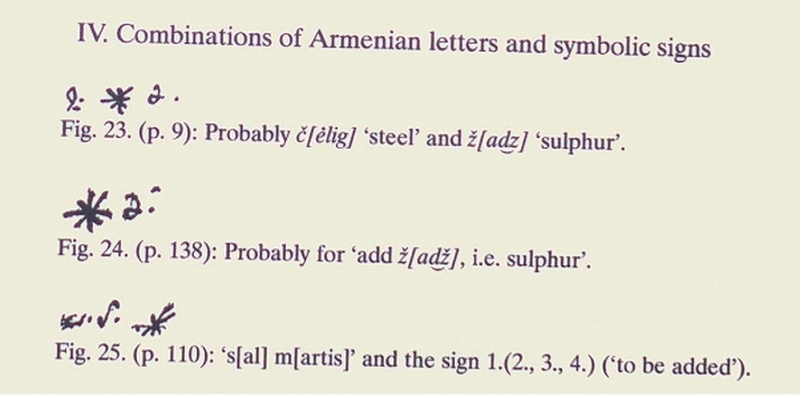
Illustration: Examples of combinations of Armenian letters and symbolic signs (source: Tryjarski 2005: 17
Tryjarski 2005: 17 / komentarz/comment/r / Tryjarski, Edward 2005. Armeno-Kipchak Texts in the Alchemical Treatise by Andrzej Torosowicz (17th Century). Warszawa: Dom Wydawniczy Elipsa.
).Examples of texts
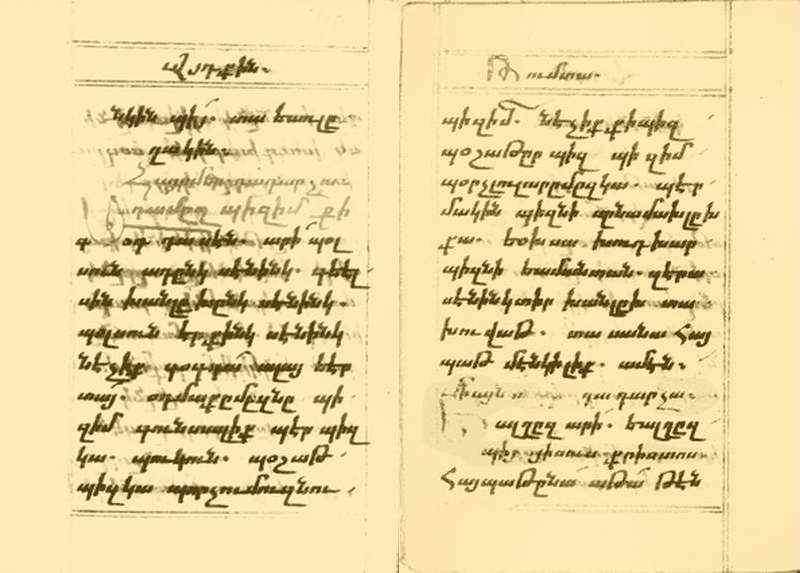
The Armeno-Kipchak texts found below come from: The minutes of the Armenian ecclesiastical court of Lvov from years 1625-1630 in the Armeno-Kipchak language, Armeno-Kipchak Texts in the Alchemical Treatise by Andrzej Torosowicz (17th Century) (referred here as ‘Andrzej Torosowicz’s manuscript’i Dictionnaire arméno-kiptchak. D’après trois manuscrits des collections viennoises. Tome I. (referred here as ‘Armeno-Kipchak dictionary’), all three by Edward Tryjarski; as well as from a reprinted manuscript ‘Arm.5’ found in the National Library of Paris.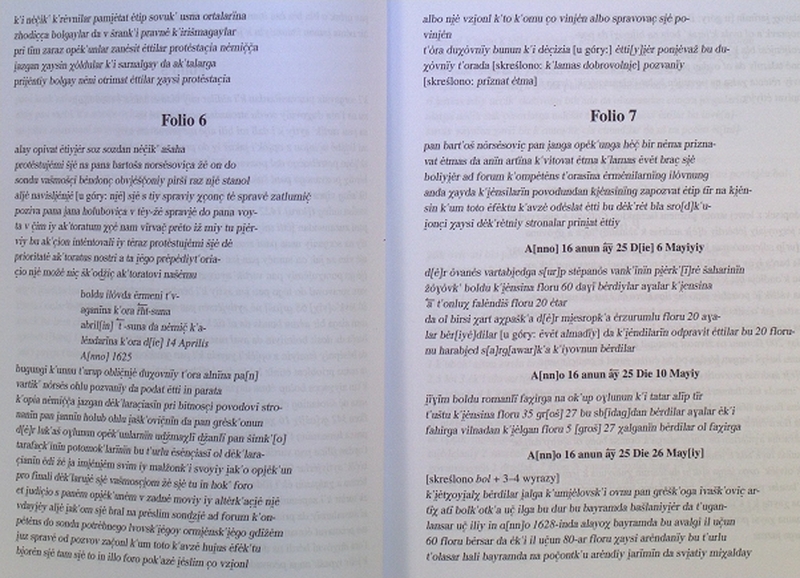
Folio 6 i 7 of The minutes of the Armenian ecclesiastical court of Lvov from years 1625-1630 in the Armeno-Kipchak language in Edward Tryjarski’s transcription (source: Tryjarski 2010: 40-41
Tryjarski 2010: 364-365 / komentarz/comment/r / Tryjarski, Edward 2010. Zapisy sądu duchownego Ormian miasta Lwowa za lata 1625-1630 w języku ormiańsko-kipczackim. Kraków: Polska Akademia Umiejętności.
).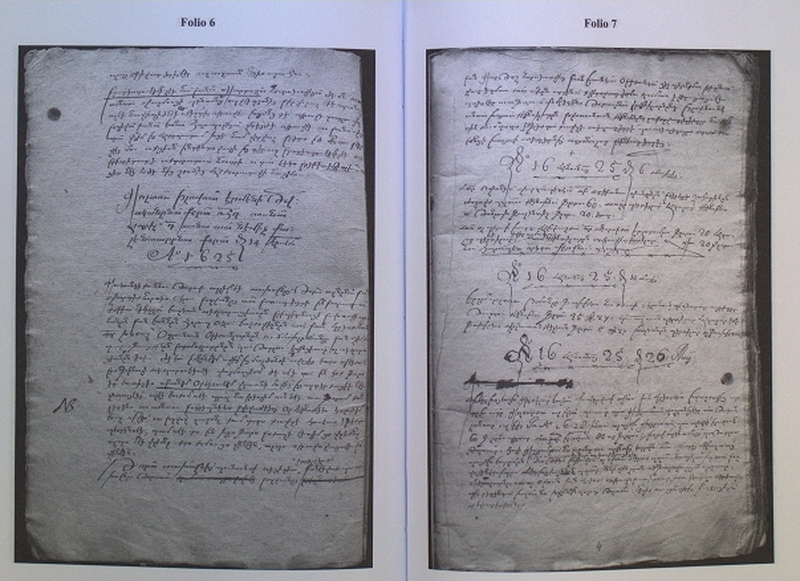
Folio 6 i 7 of The minutes of the Armenian ecclesiastical court of Lvov from years 1625-1630 in the Armeno-Kipchak language - facsimile of the original (source: Tryjarski 2010: 364-365
Tryjarski 2010: 364-365 / komentarz/comment/r / Tryjarski, Edward 2010. Zapisy sądu duchownego Ormian miasta Lwowa za lata 1625-1630 w języku ormiańsko-kipczackim. Kraków: Polska Akademia Umiejętności.
).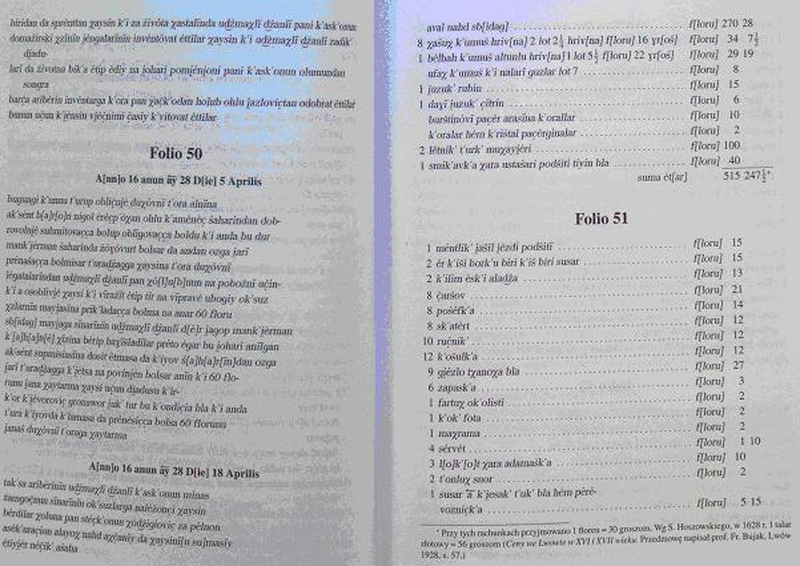
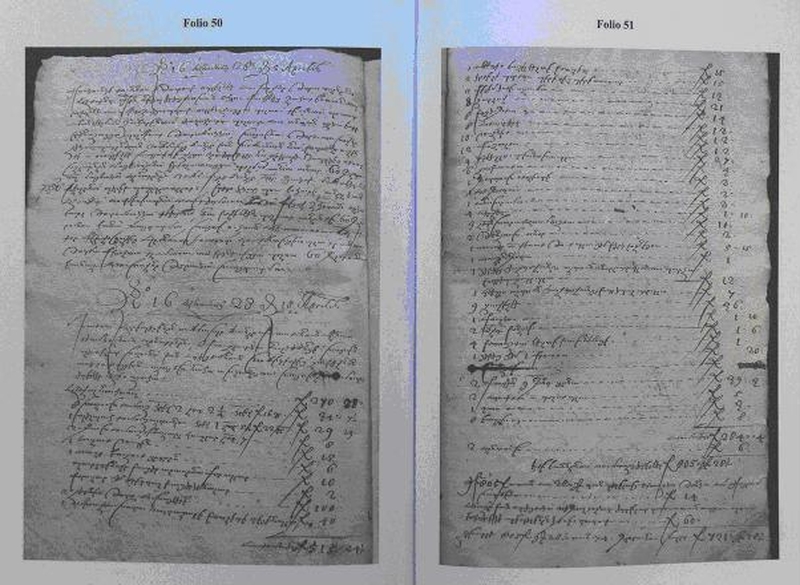
Folio 50 i 51 of The minutes of the Armenian ecclesiastical court of Lvov from years 1625-1630 in the Armeno-Kipchak language - facsimile of the original (source: Tryjarski 2010: 92-93
Tryjarski 2010: 92-93 / komentarz/comment/r / Tryjarski, Edward 2010. Zapisy sądu duchownego Ormian miasta Lwowa za lata 1625-1630 w języku ormiańsko-kipczackim. Kraków: Polska Akademia Umiejętności.
).
Folio 50 i 51 of The minutes of the Armenian ecclesiastical court of Lvov from years 1625-1630 in the Armeno-Kipchak language - facsimile of the original (source: Tryjarski 2010: 408-409
Tryjarski 2010: 408-409 / komentarz/comment/r / Tryjarski, Edward 2010. Zapisy sądu duchownego Ormian miasta Lwowa za lata 1625-1630 w języku ormiańsko-kipczackim. Kraków: Polska Akademia Umiejętności.
).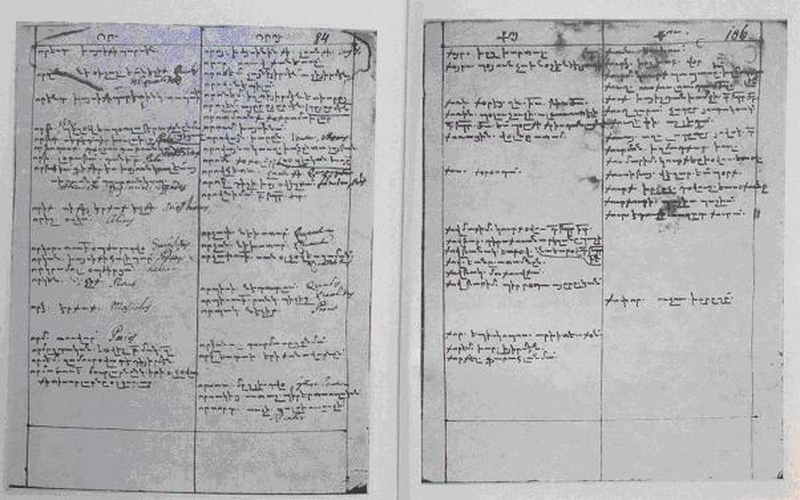
A fragment of one of the Vien manuscripts which was used to create E. Tryjarski’s Armeno-Kipchak dictionary (source: Tryjarski 1972: 888-889
Tryjarski 1972: 888-889 / komentarz/comment/r / Tryjarski, Edward 1972. Dictionnaire arméno-kiptchak. D’après trois manuscrits des collections viennoises. Tome I. Warszawa: PWN.
).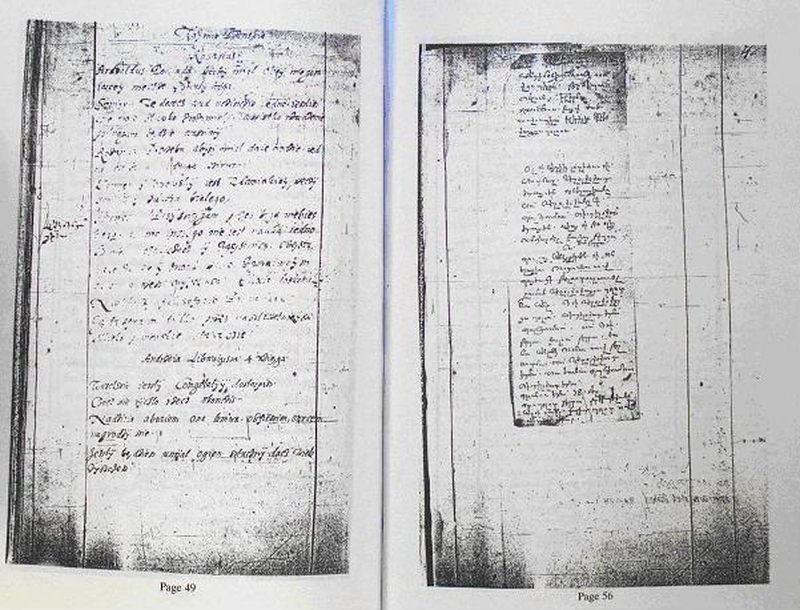
Facsymile of page 49 and 56 of Andrzej Torosowicz’s manuscript containing fragments in Armeno-Kipchak (source: Tryjarski 2005: 108-109
Tryjarski 2005: 108-109 / komentarz/comment/r / Tryjarski, Edward 2005. Armeno-Kipchak Texts in the Alchemical Treatise by Andrzej Torosowicz (17th Century). Warszawa: Dom Wydawniczy Elipsa.
).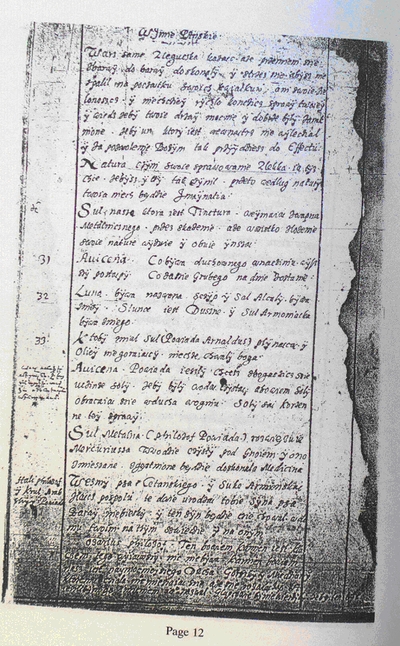
Page 12 of Andrzej Torosowicz’s manuscript in Polish with commentary in Armeno-Kipchak on the margin (source: Tryjarski 2005: 98
Tryjarski 2005: 98 / komentarz/comment/r / Tryjarski, Edward 2005. Armeno-Kipchak Texts in the Alchemical Treatise by Andrzej Torosowicz (17th Century). Warszawa: Dom Wydawniczy Elipsa.
).
’Our Lord’ prayer in the Armeno-Kipchak language (Arm.5.) (source: www.qypchaq.unesco.kz).
ISO Code
only codes for language family available:
ISO 639-2 tut
ISO 639-5 trk
ISO 639-2 tut
ISO 639-5 trk
- obj1
- przyp1
- Tekst ustawy we współczesnym języku armeńskim
- Stachowski 2010: 213
- Pisowicz 2009: 11
- por. Berta 2006: 158
- Tyszkiewicz 1989: 149
- Garkavec 1979: 5-6
- Garkavec 1979: 5
- Berta 2006: 163
- Tryjarski 2005: 11
- por. Tryjarski 2005: 9
- Tryjarski 2005: 10
- por. Łapicz 1986: 27
- Tryjarski 1989: 110
- Garkavec 1993: 587
- por. Garkavec 1993: 587
- Stachowski 2010: 213
- Róna-Tas 2006: 135
- Krymskij 1930 za: Garkavec 1993: 586
- Garkavec 1993: 588
- Tyszkiewicz 1989: 202
- Garkavec 1987: 3
- Pisowicz 2009: 10
- Łapicz 1989: 39
- Berta 2006: 158
- Garkavec 1979: 6
- Tryjarski 2010: 17
- Tryjarski 2005: 13
- Tryjarski 2010: 18
- Stachowski 2010: 214
- Berta 2006: 165
- Stachowski 2010: 218
- Stachowski 2010: 222
- Tryjarski 2010: 21
- Tryjarski 2010: 21-22
- Tryjarski 2010: 25
- Tryjarski 2010: 28
- Tryjarski 2010: 27
- Tryjarski 2005: 11-12
- Tryjarski 2010: 19
- Pisowicz 2009: 12
- Tryjarski 2010: 11
- Tryjarski 2010: 15
- Tryjarski 2010: 17-18
- Tryjarski 2010: 16
- Tryjarski 2010: 7
- Tryjarski 2010: 8
- Tryjarski 2005: 7
- Tryjarski 2005: 12
- Tryjarski 2005: 9
- Tryjarski 2005: 17
- Tryjarski 2010: 40-41
- Tryjarski 2010: 364-365
- Tryjarski 2010: 92-93
- Tryjarski 2010: 408-409
- Tryjarski 1972: 888-889
- Tryjarski 2005: 108-109
- Tryjarski 2005: 98
- Rykała 2011
- zagrożenie języków / language endangerment
- Ilustracja 1
- Ilustracja 2
- Ilustracja 3
- Ilustracja 10
- Ilustracja 9
- Ilustracja 8
- Ilustracja 7
- Ilustracja 6
- Ilustracja 5
- Ilustracja 4