Romani dialects
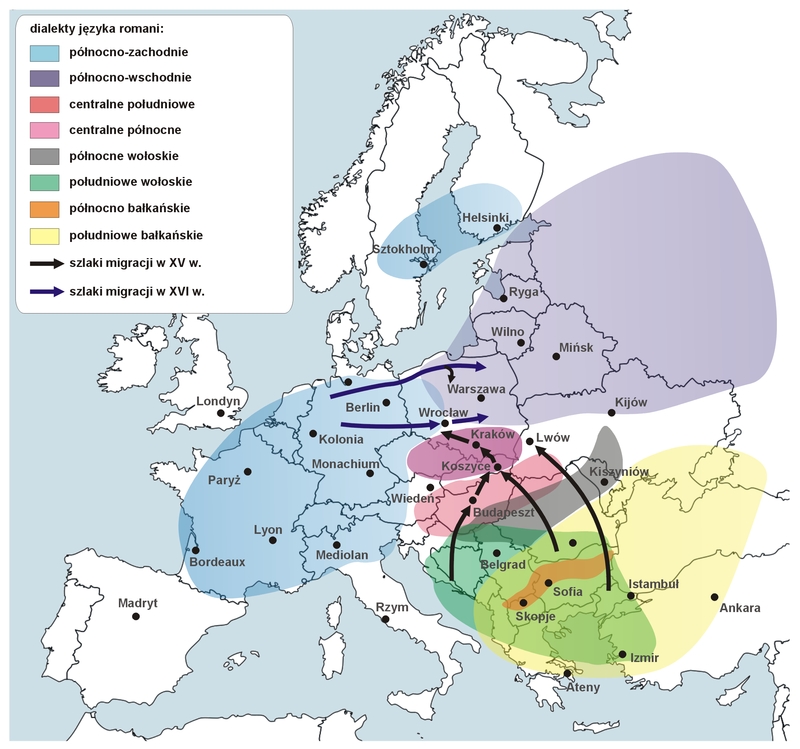
map ed.: Jacek Cieślewicz
Kinship and identity
The Romani language belongs to the New Indo-Aryan language group. It branched out from Sanskrit but it did not develop as a literary or religious language. Rather, its evolution has been solely on the grounds of it being used by people and society. It is an oral language, not a written one. So far it has been not possible to explain the given phases of its development, hence the lack of any historical grammars of the language. Moreover, as different Roma groups kept travelling for centuries across different lands, their language branched out to many dialects. These dialects evolved, lost some of their vocabulary which was replaced by the vocabularies of other languages that the Gypsies encountered. Today the Romani language has no supra-dialectal form. Different Gypsy groups have difficulties with understanding each other - and the further the geographical distance is between these groups, the more challenging it is for them to communicate.Marcel Courthiade, a French Gypsy of Greek descent, research worker at INALCO and head of the Language Committee of the International Romani Union, carried out a modern classification of Romani dialects. According to this classification, there are four main dialectal groups of the Romani language:
- Balkan-Carpathian-Baltic which further can be divided into:
- Balkan dialects
- Carpathian dialects (including the Bergitka Romani dialect spoken in Poland)
- Baltic dialects (including the Polska Roma dialect spoken in Poland)
- Gurbeti-Cerhari. The following dialects belong to this group: gurbeti, džambazi, cerhari and other which are used by Gypsies from Serbia, Macedonia and Greece.
- Kalderash-Lovari Dialects of Kalderash and Lovari Gypsies who live in Poland can be counted as examples.
- Iberia-Romani (based on the grammar structures of: Spanish, Catalonian, Portuguese)
- Anglo-Romani (based on the grammar of the English language)
It is also worth to mention the Sinto-Manuš dialects which have been developing on their own for so long that it is virtually impossible for them to communicate with users of other dialects. The Sinti dialect is used by Gypsies living in Germany, whereas Manus is spoken in France. A small number of Sinti Gypsies also live in Poland.
Identity
Gypsies/Roma people define their identity in various ways but it is always defined in opposition to the gadje (gadje, in Polish spelling gadźo - a non-Roma, foreigner). They believe that the cultural barrier which they use to separate themselves from the world of outer influence will protect them from the loss of their own identity. Regardless of the way it is defined by various groups, the romanipen (sense/essence of being Roma/Gypsy) always refers to tradition. The most basic rules according to which Roma communities live are the following:- manifesting one's ethnic belonging (particularly the belonging to the given group and, thus, the loyalty to group members which follows it),
- expressing dislike towards the non-Roma population when among the community,
- using the Romani language whenever it is possible and manifesting its superiority over other languages (and other Romani dialects as well which are deemed to be "contaminated" or "less pure"),
- patyv, the principle of mutual respect and honour, also hospitality,
- phuripen, the principle of respecting the elderly,
- ćaćipen, the imperative of being truthful
ISO Code
ISO 639-2 rom
ISO 639-3 rom
Carpathian Romani (Bergitka Roma) - rmc
ISO 639-3 rom
Carpathian Romani (Bergitka Roma) - rmc
- Ustawa w dialekcie bergitka roma
- Ustawa w dialekcie polska roma
- Bartosz 2004
- artykuł romskojęzyczny z "Romano Atmo" 2
- artykuł romskojęzyczny z "Romano Atmo" 1
- zagrożenie języków / language endangerment
- Cyganie w Europie
- lekcja rysunków w romskim gimnazjum
- elementarz romski w bergitka roma
- elementarz romski w polska roma
- strona z elementarza polska roma