High German varieties outside Silesia
Identity and kinship
Varieties used in Poland
• The Indo-European languages• Germanic languages
• West Germanic languages
• High German
• German
• Central German
• East Central German
• High Prussian• Silesian
• West Central German
• Rhine Franconian
• Palatine German
• Upper German
• Alemanian
• Swabian
The High German dialects from Germany, Austria and Switzerland as well as those used in diaspora, are the ones closely related to the described dialects. It is worth noting that Palatine German and Swabian are still spoken in Palatine and Swabia respectively (although for obvious reasons these dialects are influenced neither by Polish nor Ukrainian).
Other related High German variations are treated as separate languages (e.g. Luxembourgian); also Yiddish and Vilamovian (described in separate profiles), are assigned by the Ethnologue to High German language family (Lewis et al. 2013
 Lewis i in. 2013 / komentarz/comment/r /
 Lewis, M. Paul i in. (red.) 2013. Ethnologue: Languages of the World. Dallas: SIL International. [http://www.ethnologue.com].
 ).
).Other related languages, but not directly, are Dutch and Afrikaans. Dutch/Low German language complex, directly derived from the Old Saxon, is related to the English language. To the West German language group, in a broad sense, belong among others Afrikaans, Low German and Dutch (Lewis et al. 2013
Lewis i in. 2013 / komentarz/comment/r / Lewis, M. Paul i in. (red.) 2013. Ethnologue: Languages of the World. Dallas: SIL International. [http://www.ethnologue.com].
).Language or dialect?
The High German variations are sometimes called languages, dialects or local dialects, which, to a great extent, depends on the degree of accuracy and on the context.There are various hierarchical classifications of the High German variations. For instance, Wolfgang Putschke classified the High Prussian dialectal complex( Dialektverband) as part of the East Central German dialectical space(Dialektraum), together with the following dialectical complexes: Thuringian, Upper Silesian, Sorbian, Silesian, Czech and North Moravian. Putschke divided the High Prussian dialects into two groups of dialects:
- breslausche – in the eastern part of the area - in these variations the standard prefix -er is replaced by the local formva-,
- breslausche – in the western part of the area - in these variations the standard suffix-er is replaced by the local formsver-, vor-.
Identity cases
Łódź
Fritz Weigelt (2010: 51-52Weigelt 2010 / komentarz/comment/r / Weigelt, Fritz 2010. „Der Lodzer Mensch”, w: E. Effenberger. Das Lodzerdeutsch. Mönchengladbach: Archiv der Deutschen aus Mittelpolen und Wolhynien. 50-55.
) argues that the identity of a man from Łodź (Lodzer Mensch) cannot be understood the same way, as for example, the identity of a man from Berlin. The Łodzian people varied in terms of ethnic groups and ethnic divisions, which strengthen religious divisions. The Poles were predominantly Catholics, and the Germans were Protestants. Worth emphasising is the fact that according to Weigelt (2010: 52Weigelt 2010 / komentarz/comment/r / Weigelt, Fritz 2010. „Der Lodzer Mensch”, w: E. Effenberger. Das Lodzerdeutsch. Mönchengladbach: Archiv der Deutschen aus Mittelpolen und Wolhynien. 50-55.
), the German Catholics (who constituted 10% - it is unknown whether is was the percentage of Catholic, German or total population) and Polish Protestants did not form strong bonds with their brothers in faith of different ethnic background. A separate cultural life developed and different literature was read (Weigelt 2010: 53Weigelt 2010 / komentarz/comment/r / Weigelt, Fritz 2010. „Der Lodzer Mensch”, w: E. Effenberger. Das Lodzerdeutsch. Mönchengladbach: Archiv der Deutschen aus Mittelpolen und Wolhynien. 50-55.
). Moreover, the Łodź High German dialect was developing slowly and also could not unite its speaker.The Galician Germans preserved the identity of their native countries (especially Rhineland and Palatinate - although Ludwig Finckh (1931: 13
Finckh 1931 / komentarz/comment/r / Finckh, Ludwing 1931. „Den Deutschen in Kleinpolen”, w: Gedenkbuch zur Erinnerung an die Einwanderung der Deutschen in Galizien vor 150 Jahren. Herausgegeben vom Ausschuß der Gedenkfeier. Posen: Verlag der Historischen Gesellschaft für Posen. 13-14.
) also names Hessia and Wirtemberg. Most probably, they were considered compatriots in their native countries - cf. E. Christmann’s poem (1931aChristmann 1931a / komentarz/comment/r / Christmann, E. 1931a. „E Gruß an die Pälzer im Oschte”, w: Gedenkbuch zur Erinnerung an die Einwanderung der Deutschen in Galizien vor 150 Jahren. Herausgegeben vom Ausschuß der Gedenkfeier. Posen: Verlag der Historischen Gesellschaft für Posen. 114-115.
) E Gruß an die Pälzer im Oschte (“Greetings to the Palatinates in the East”).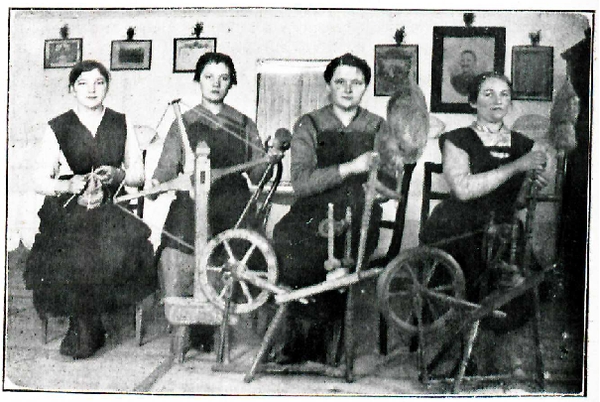
Galician girls by home appliances (after: Kollauer 1931: 168bKollauer 1931 / komentarz/comment/r /
Kollauer J. 1931. „Die Literatur der Josefinischen Ansiedler in Kleinpolen (Galizien)”, w: Gedenkbuch zur Erinnerung an die Einwanderung der Deutschen in Galizien vor 150 Jahren. Herausgegeben vom Ausschuß der Gedenkfeier. Posen: Verlag der Historischen Gesellschaft für Posen. 158-174.
)
Kollauer 1931 / komentarz/comment/r / Kollauer J. 1931. „Die Literatur der Josefinischen Ansiedler in Kleinpolen (Galizien)”, w: Gedenkbuch zur Erinnerung an die Einwanderung der Deutschen in Galizien vor 150 Jahren. Herausgegeben vom Ausschuß der Gedenkfeier. Posen: Verlag der Historischen Gesellschaft für Posen. 158-174.
)Bambrzy
As Rogers Brubaker (1998: 296-297Brubaker 1998 / komentarz/comment/r / Brubaker, Rogers 1998. „Myths and Misconceptions in the Study of Nationalism”, w: John Hall (red.) The State of the Nation: Ernest Gellner and the Theory of Nationalism. Cambridge: Cambridge University Press. 272-305.
) emphasises, the division between Polish and German nationality in modern times was sometimes very clear (especially when the issues of ethnicity, language and religion overlapped), and sometimes quite blurred, especially in situations when German Catholics coexisted with Poles (Brubaker 1998: 297Brubaker 1998 / komentarz/comment/r / Brubaker, Rogers 1998. „Myths and Misconceptions in the Study of Nationalism”, w: John Hall (red.) The State of the Nation: Ernest Gellner and the Theory of Nationalism. Cambridge: Cambridge University Press. 272-305.
).Bambrzy (in German. Bamberger~Bamber, informally also Gelbfuss, in the Poznań Low German local dialect Jeiafout – cf. Koerth 1904: 68) are an ethographic group of the Upper Franconian descent. They came to Poznań, invited by its authorities to populate the surroundings village, depopulated as a result of the 3rd Northern War and the plague. The city wanted to populate the village and in consequence, increased their income. New residents settled in Luboń /Luban (1719), Dębiec/Dembsen, Bonin and Winiary (1730), in Rataje and Wilda (1746-1747), in Jeżyce/Jersitz and in Górczyn (1750-1753). All the above-mentioned areas are today the districts of Poznań, except Luboń, which in 1954 was proclaimed a city.
All the newcomers were Roman Catholics. Under the king August II decree from 1710, migrants who wanted to settle needed a befitting document concerning their religion (Paradowska a
Paradowska a / komentarz/comment/r / Paradowska, Anna a. „Z historii Bambrów”, w: Poznańscy Bambrzy wczoraj i dziś.[http://www.poznan.pl/mim/turystyka/historia-bambrow,p,4791,4792.html]
). Bambrzy preferred to participate in the life of local parish, although the authorities guaranteed them the German speaking ministry by the Fransciscan Church on Wzgórze Przemysła (the Hill of Przemysł). Karolina Bielenin-Lenczowska argues that Bambrzy underwent the process of Polonisation so quickly, because their Upper German dialect was not understood by the German residents of Poznań. Eduard Koerth (1929:80Koerth 1929 / komentarz/comment/r / Koerth, Eduard 1929. „Die Polonisierung der „Bamberger““, w: Ostdeutscher Heimatkalender 80-84.
) believes that the Polonisation followed the manipulation of Polish clergy, who tried to identify Catholicism with Polishness and spread the belief among common people that “a pope was a Pole, Mother Mary was a Pole, and Catholicism especially Polish” (Koerth 1929: 80Koerth 1929 / komentarz/comment/r / Koerth, Eduard 1929. „Die Polonisierung der „Bamberger““, w: Ostdeutscher Heimatkalender 80-84.
; further on the same author writes about using religious education at school as a mean of Polonisation).Bambrzy maintained relations with Poles and did not avoid mixed marriages. As Maria Paradowska writes, some families Polonised as early as the beginning of the 19th century, others somewhat later. In all ethnic-based conflicts in the 19th and 20th centuries (Kulturkampf, Wielkopolska Uprising, World Wars), Bambrzy always supported Poland. It did not protect them, however, from discrimination in communist Poland (after 1945).
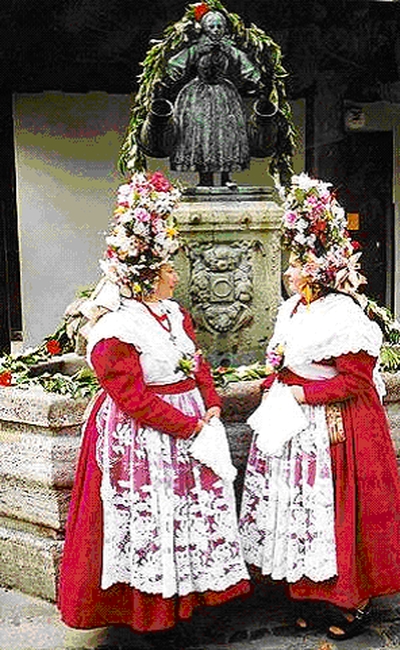
Nowadays, Bambrzy are associated predominantly with a folk outfit, which combines elements from Wielkopolska, Lubuskie district, Łużyce as well as Saxon and Upper Frankonian elements and the burgher fashion of biedermeier (source of illustrations: Paradowska b
Paradowska b / komentarz/comment/r / Paradowska, Anna b. „Strój bamberski”, w: Poznańscy Bambrzy wczoraj i dziś. [http://www.poznan.pl/mim/turystyka/bamberski-stroj,p,4791,4793.html]
)The Mennonites
Following the decree of Joseph II, the Mennonites settled in Galicia among other German families (the capital letter is justified as we treat this society group as ethno-confessional one).Mennonites are Christians,named after Menno Simons, Dutch preacher and early leader of the Anabaptist movement - a group of Christians who distinguish themselves with radical pacifism, based on a gospel truth of loving thy neighbour; they also deny the children baptism.
The Galician Mennonites originated from Switzerland. They escaped because of persecution. They came to Galicia from Palatinate and other German states. They could settle here under certain conditions: they were to be treated as Lutherans but the moment they had more than 100 families, they were allowed to build their own church (in reality they managed to built it sooner); they were free from military service; members of other churches, however, were not allowed to convert into the Mennonite denomination.
Out of initially 28 families 11 (including most probably all the Amish) emigrated again, this time to the Russian Empire - initially to the area of Chernihiv, just to move later on to Volhynia. The majority of this group descendants, eventually migrated to the USA (up to 1875).
The Mennonites, who stayed in Galicia, experienced quite rapid population growth. In 1868 the preacher Johannes van der Smissen, estimated their number to 400 people (80 families). In years 1875-1883, the poorer half of the Mennonite population (at that time 75 families) left Galicia and migrated to the USA (mainly Kansan and Minessota).
At the turn of the 20th century, the Mennonites no longer lived in their traditional household, but partly moved to cities and studied at universities.
In 1909 the community was officially registered. In 1910, an association “Mennonite” was created in order to socially and culturally promote the Galician Mennonites. In 1913 in Lviv, the Mennonites started publishing their own magazine Mennonitisches Gemeindeblatt.
As Pauls and Krahn (1956
Pauls i Krahn 1956 / komentarz/comment/r / Pauls, H. i Cornelius Krahn 1956. „Galicia (Poland & Ukraine).”, w: Global Anabaptist Mennonite Encyclopedia Online. [http://www.gameo.org/encyclopedia/contents/G22.html]
) emphasises, the relations between the Galician Mennonites and Polish authorities were always good. In 1925 in Lviv, they created their own dormitory (Schülerheim), run by the Schroeders by the Molochna River in Ukraine (the settlement was created by the Prussian Mennonites).After the Molotov–Ribbentrop Pact, the German population of Galicia was displaced, which also affected the Mennonites, who were moved into the occupied, by the Third Reich, areas of Poznań and Toruń. After the war, the Mennonites fled to West Germany (Pauls and Krahn 1956
Pauls i Krahn 1956 / komentarz/comment/r / Pauls, H. i Cornelius Krahn 1956. „Galicia (Poland & Ukraine).”, w: Global Anabaptist Mennonite Encyclopedia Online. [http://www.gameo.org/encyclopedia/contents/G22.html]
).In 1951, the Galician Mennonites joined their Gdańsk fellow believers in building a Mennonite organisation in Urugway (Bender and Bergmann 1987
Bender i Bergmann 1987 / komentarz/comment/r / Bender, Harold S. i Johannes Bergmann 1987. „Konferenz der Mennonitengemeinden in Uruguay”, w: Global Anabaptist Mennonite Encyclopedia Online. [http://www.gameo.org/encyclopedia/contents/K6522.html]
).In the USA, the Mennonites of the Swiss origin (including the Amish) still use Pennsylvania German language (Pennsylvania German~Dutch~Deitsh), which is derived from Palatine German. According to the Ethnologue, this language is spoken by 133.000 people (Lewis et al. 2013
Lewis i in. 2013 / komentarz/comment/r / Lewis, M. Paul i in. (red.) 2013. Ethnologue: Languages of the World. Dallas: SIL International. [http://www.ethnologue.com].
). The Pennsylvania German language version of Wikipedia stands out among other media created in this language http://pdc.wikipedia.org).Jews
Also the Jews spoke the High German variations. Despite the fact that some authors classify the Yiddish variations as High German (e.g. Lewis et al. 2013Lewis i in. 2013 / komentarz/comment/r / Lewis, M. Paul i in. (red.) 2013. Ethnologue: Languages of the World. Dallas: SIL International. [http://www.ethnologue.com].
), the Jews historically residing in present-day Poland, had to use the languages spoken by the rest of the population. On the one hand, it concerns the local dialects e.g. Julius Krämer (1979: XIXKrämer 1979 / komentarz/comment/r / Krämer, Julius 1979. Unser Sprachschatz. Wörterbuch der galizischen Pfälzer und Schwaben. Stuttgart-Bad Cannstatt: Hilfskomittee der Galiziendeutschen.
) writes about the Jews who knew Palatinate German. On the other hand, educated Jews from cities used the Standard German language (maskilim). The Jews who lived in Poznań, even after Poland regained independence, preferred German schools and generally shown pro-German political orientation (Kawski 2010Kawski 2010 / komentarz/comment/r / Kawski, Tomasz 2010. „Poznań”, w: Wirtualny Sztetl [http://www.sztetl.org.pl/pl/city/poznan]
).In this context, it is interesting to analyse the national identity of a German-speaking Pole and Jew, presented by the Galician writers, Moritz Rappaport and Leo Herzberg-Fränkel who were part of the trend maskilim.Rappaport, whose works described the fall of the Polish Republic, summarised his identification in the following words:
Ein Pole und ein Jude sein
Das ist das Unglücks Doppelkranz.
(“to be at the same time Polish and Jewish
is a double bad luck”)
ISO Code
ISO-639-3: German - deu,
Palatine - pfl,
Swabian - swb.
The Library of Congress MARC 21 standard - ger;
historical variations are: gmh – Middle High German, goh – Old High German;
other German languages - gem.
SIL (13 ed. The Ethnologue): ger; at present The Ethnologue: deu.
Palatine - pfl,
Swabian - swb.
The Library of Congress MARC 21 standard - ger;
historical variations are: gmh – Middle High German, goh – Old High German;
other German languages - gem.
SIL (13 ed. The Ethnologue): ger; at present The Ethnologue: deu.
- przyp01
- Żebrowska 2002
- Lewis i in. 2013
- Mitzka 1959
- Kargel 1941
- Krämer 1979
- Czoernig 1857
- Mitzka 1943
- Weigelt 2010
- Breyer 2006
- Urban 2004
- Sprothen 2007
- Paul 1962
- Paul 1965
- Finckh 1931
- Christmann 1931a
- Kollauer 1931
- Brubaker 1998
- Paradowska a
- Paradowska b
- Koerth 1929
- Pauls i Krahn 1956
- Bender i Bergmann 1987
- Kawski 2010
- Żebrowska 2004
- Krämer 1931
- Effenberger 2010
- Beck-Vellhorn i Scharlach 1936a
- Haeufler 1846
- Kossmann 1935
- Kłańska 1991
- Karasek-Langer i Strzygowski 1932
- Karasek-Langer Alfred i Elfriede Strzygowski 1938
- Goetze 1922
- Schmit 1942
- Beck-Vellhorn i Scharlach 1936b
- Müller 1962
- zagrożenie języków / language endangerment
- Baner reklamowy
- Odsetek Niemców w gminach
- Odsetek Niemców w-m
- Gwary niemieckie w Polsce wg Maurmanna
- PGR-Arbeiter
- książka Göttnera
- Urna ze swastykami pochodząca z Łódzkiego
- Izoglosy w Prusach
- Rozmieszczenie Niemców w Polsce środkowej IIRP
- Lodzer Zeitung
- Galicyjskie dziewczęta przy pracy
- Współcześni Bambrzy
- Izoglosy w gwarach Galicji
- Tekst szryftem gotyckim
- Zapożyczenia polskie i ukraińskie
- Schemat maselnicy
- Zapożyczenia w gwarze łódzkiej
- Podania
- Analiza Krämera
- Pieśń z Woli-Oblasznicy
- Huasnpolka – szwabski taniec z Machlińca
- Granica dialektów w płn. Polsce
- tabela do gwar Galicji
- Milch w Biskupiej Górce